
Property Investment Blog Insights
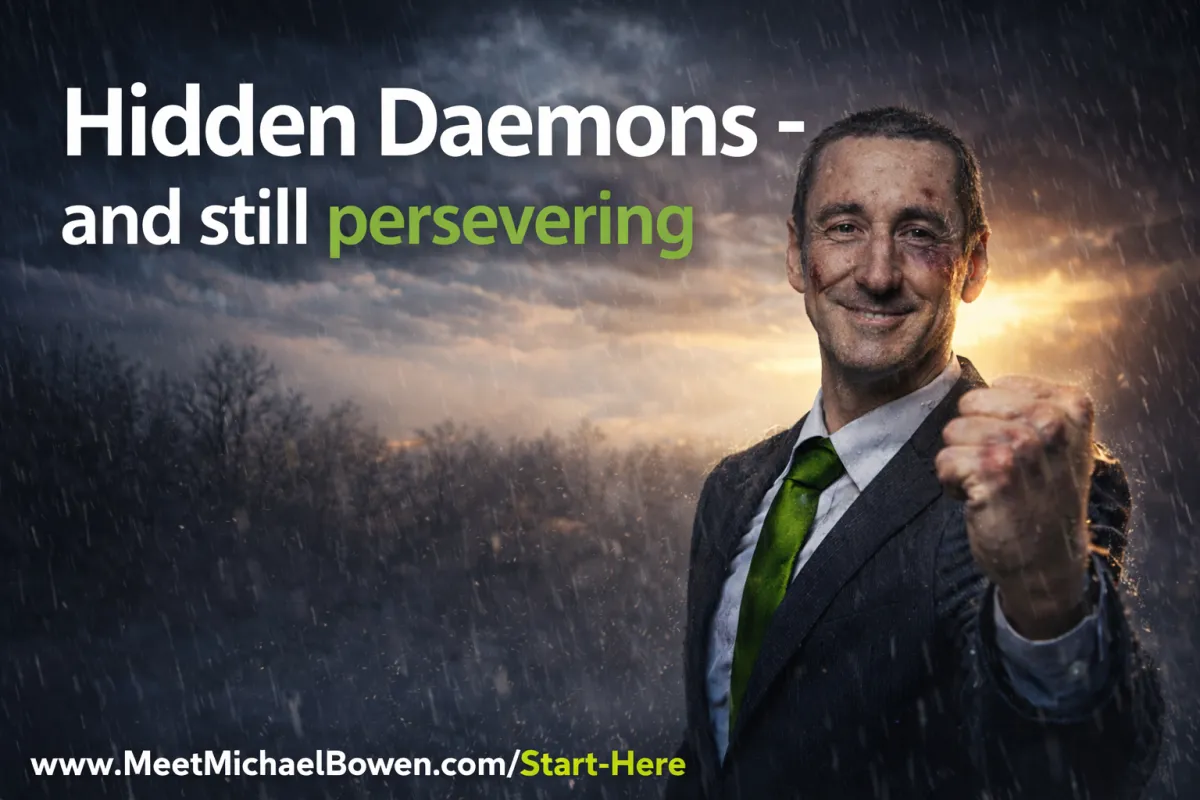
Success despite Depression - What you don't see behind my wins
The Other Side: What Success Doesn’t Show
You’ve seen the wins.
The confidence.
The projects that worked.
The really good days.
If you’ve known me long enough, you’ve seen the travel — Thailand, Fiji, diving in the Philippines. You’ve seen the happiness I’ve projected. You’ve seen the version of me where things go well. The version that wakes up screaming with joy, full of drive, raw energy, hungry to win.
This is not that story.
This is the other side.
The part I haven’t shown.
The part no dose of motivation or years of personal development can really help with.
The darkness we don’t talk about.
I’m not sharing this for sympathy.
I’m not asking to be understood.
I’m not asking anyone to hold this for me.
I’m holding it.
I’m responsible.
I’m just putting the truth on the table.
This is the dark I deal with.
This is where I struggle.
This is where I have failed.
If you’re listening for hope, lessons, or a clean takeaway — you won’t get that here.
What you’ll get is accuracy.
Living With Depression and TRT
This is what it looks like when you stop editing yourself for comfort — physically and mentally.
I live with ongoing depression. It’s diagnosed. It’s medicated. That doesn’t make me dramatic. It does make me tired sometimes.
For the past few years, I’ve had to rely on testosterone replacement therapy just to maintain a baseline of emotional resilience, psychological stability, and energy. Without it, I don’t function the same anymore. Something shifted during the COVID period, and my body never fully came back.
There are periods of flatness — low motivation — that from the outside can look like laziness. From the inside, it feels like gravity.
My nervous system is fatigued from years and years of responsibility. My body often signals limits before my mind is willing to listen — even when I don’t.
Recently, I sat in the ER in excruciating pain, unable to pull myself out of a dark place.
I carry the pressure to function consistently, even when my capacity fluctuates like any human’s would. I’m afraid of what happens if that support system stops working. And I’m even more afraid of what happens if I stop working — twenty-four seven.
The Invisible Struggle
Here’s the hardest part.
I look fine.
I sound fine.
I show up.
I perform competently.
Which means when I’m struggling, it’s invisible — to others and often to myself.
I don’t get social permission to slow down because nothing is visibly broken. Over the years, I’ve learned how to override my body. I’ve learned how to push through signals that were supposed to tell me to stop.
That skill looks like strength from the outside.
Internally, it’s a calculation running constantly:
Can I still make it through today?
This is where damage accumulates.
The dark side of success is waking up already carrying a suffocating weight of decisions. Constantly scanning for risks. For things that might go wrong. Not dramatically — quietly, continuously.
And when all I can manage is the bare minimum, what follows isn’t relief.
It’s shame.
It’s guilt.
It’s telling myself I should be able to handle more.
The Weight of Decisions
What I crave in those moments isn’t productivity.
It’s disengagement.
Distraction.
A way to feel self-agency again.
Because I live trapped between obligation and self-preservation.
Joy doesn’t arrive easily. And when it does, it comes attached to responsibility.
Some mornings I wake up already behind — not because of anything specific, but because my mind boots up accounting for everything that could go wrong.
It isn’t always panic.
It’s vigilance.
And when you live like that long enough, even rest starts to feel unsafe.
I have the data to prove it. My HRV drops into the teens when it should be in the forties. Stillness doesn’t feel like peace — it feels like exposure.
So I stay busy. Not because I love productivity, but because stopping gives the weight room to speak.
Hurting People I Care About
This part is harder to say.
There have been times I’ve said and done bad things to good people — people I cared about.
Not because I wanted to hurt them, but because fear was louder than care.
I’ve been sharp.
Defensive.
Nasty.
Not as strategy — as reaction.
Words born from exhaustion. From feeling cornered. From trying to protect something inside me that already felt under threat.
And awareness doesn’t make this lighter. It makes it heavier. Because you can watch yourself do it and know, in the moment, this is not who I want to be.
And you carry that weight.
Grief: My Dogs and My Mother
I put my soul dog down after fourteen years together. Cancer. I carry the moral weight of that decision. I haven’t fully processed that loss.
My heart dog — the one behind the camera right now — is aging. And I live with anticipatory grief, knowing he’s going too.
My mother died a few years ago. That grief was postponed. Avoided. Never fully metabolised. And now it’s coming back as my father declines and history repeats itself.
I carried grief while continuing to function, without space to collapse.
You cannot outrun grief. It leaks into your patience, your energy, your joy.
When my dog died, I didn’t just lose a companion. I lost fourteen years of routine, presence, an emotional witness.
People say I did the right thing.
Maybe I did.
But doing the right thing doesn’t remove the weight of being the one who chose it.
The Cost of Being Reliable
I’ve always been the steady one.
The supporter.
The anchor.
Through anxiety.
Through crisis.
Through trauma.
But being reliable slowly raises your threshold for availability. And when you finally need to be unavailable, people experience it as abandonment — even when it’s survival for you.
Love doesn’t always refill you when you’re empty. Sometimes it draws more from you.
Even good love becomes expensive when your reserves are low.
Work, Business, and Public Judgment
I work full-time in something that often drains more than it gives. Some days everything in my body screams no — and I force myself anyway.
I fear being judged for my creative expression. I fear my intent being misinterpreted. I feel split between who I am creatively and who I’m allowed to be professionally.
There’s a specific exhaustion that comes from pretending parts of yourself don’t exist for hours each day.
In business, I’ve lived with strained deals, cash-flow pressure, stalled assets, forced exits, legal disputes, court action, and the moral injury of doing your best and still being blamed.
I carry responsibility for partner money even when outcomes aren’t fully in my control.
And publicly? I’ve been called fake. A liar. A fraud. Worse.
Criticism doesn’t hurt most when it’s false. It hurts when it’s simplistic — when a complex life is flattened into a label.
Identity, Time, and the Loss of Old Fuel
I feel between identities.
No longer who I was.
Not yet who I’m becoming.
My old fuel — urgency, proving, being needed — burned out. It worked until it didn’t.
And there’s grief in outgrowing what once powered you.
Time doesn’t feel like mine. Obligations stack without recovery. Saying no comes with guilt. Even good things feel compulsory.
This podcast isn’t content.
It’s integration.
The Truth Underneath It All
I’m not facing many unrelated problems.
I’m facing one central challenge expressed everywhere:
Being the responsible one without a protected place to rest.
I don’t need solutions right now.
I need pauses that don’t require justification.
Rest that doesn’t have to be earned.
This isn’t collapse.
It’s a reckoning.
This is what it costs to be reliable.
This is the dark I deal with.
Take your best shot.
If this resonated, feel free to share it.
If not — that’s okay too.

I’ll motivate you to take the action on properties that can take you far into the future + teach you strategies & methods to get things done.

Facebook
Instagram
X
LinkedIn
Youtube